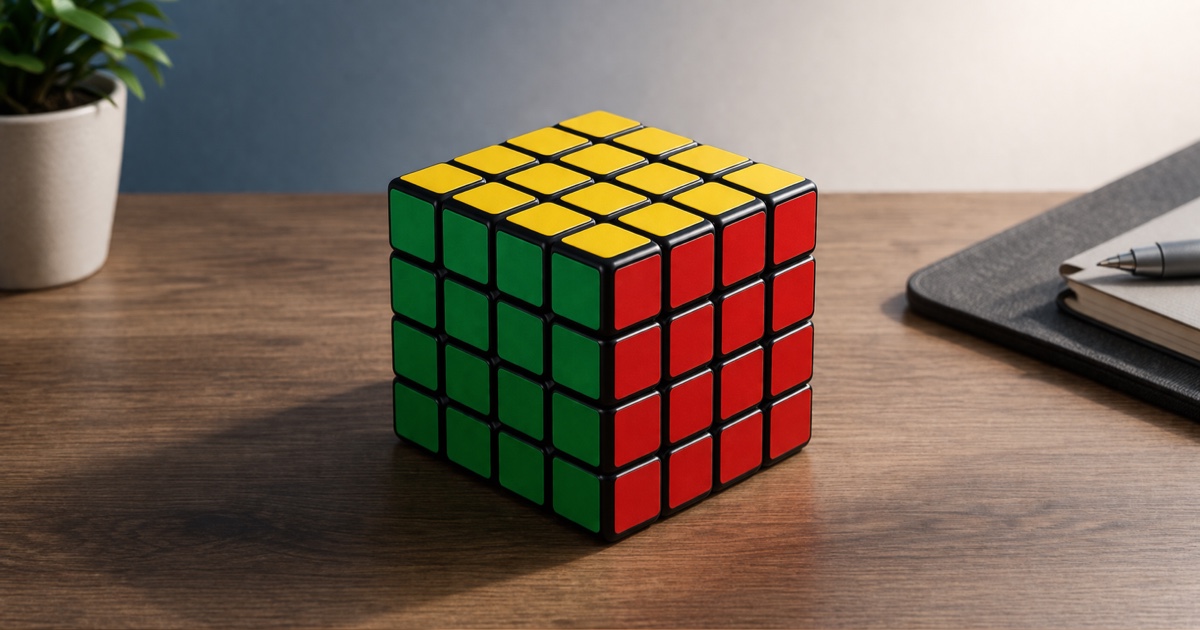
How to Solve a 4x4 Rubik's Cube
Learn to solve the 4x4 Rubik's Cube (also called the Rubik's Revenge) using the Reduction method — the most popular approach for bigger cubes. The idea is simple: first reduce the 4x4 into what looks like a 3x3, then solve it as a 3x3. We'll cover 4 steps plus special parity cases.
Notation
The 4x4 uses all standard 3x3 notation plus additional moves for the inner layers:
Standard moves (outer layer only):
- R = Right L = Left U = Up D = Down F = Front B = Back
Wide moves (outer two layers together):
- Rw = Right wide (right two layers) Lw = Left wide
- Uw = Up wide (top two layers) Dw = Down wide
- Fw = Front wide Bw = Back wide
A letter alone means clockwise 90°. Adding ' means counter-clockwise. Adding 2 means 180°.
For example: Rw = turn right two layers clockwise, Uw' = turn top two layers counter-clockwise, Rw2 = turn right two layers 180°.
Hold the cube with white center on bottom and yellow center on top for all steps.
Step 1: Solve Centers
Build the center blocks on each face. Each face of the 4x4 has 4 center pieces (a 2x2 block) that need to match. Unlike a 3x3, centers on a 4x4 can move — so you must solve them first.
Recommended order: Start with white (bottom), then yellow (opposite), then the remaining 4 sides.
This step is mostly intuitive. The key technique is using wide moves to bring center pieces together while protecting already-solved faces with outer-layer turns.
Basic center insertion — Use a wide move to bring a center piece up, turn the top to align, then reverse the wide move:
Center swap without breaking solved faces — When you need to insert a center piece but must protect other completed centers:
Tips:
- Always solve opposite faces first (white/yellow), then the remaining 4 sides.
- When inserting a center piece, use a wide move (like Rw) to bring it to the top, make your U-layer adjustment, then undo the wide move.
- Be careful not to disrupt completed centers when working on new ones.
Step 2: Pair Edges
Match each pair of edge pieces so the 4x4 behaves like a 3x3. Each edge on a 4x4 consists of 2 pieces that need to be paired together. There are 12 edges to pair.
The core technique is Slice-Flip-Slice: use a wide move (Uw) to bring edges together, perform an outer-layer move to pair them, then undo the wide move.
Basic edge pairing — Place one edge piece in the front-right position and its partner in the top. Use Uw to align them:
Flipped edge pairing — When the edge pair needs to be flipped during pairing:
Last edges pairing — For the final 3 edges, you cannot freely use Uw without breaking paired edges. Use this technique instead:
Tips:
- Work through edges freely at first — the first 8-9 edges are straightforward with the Slice-Flip-Slice technique.
- For the last 3 edges, use Dw-based moves or flipping techniques to avoid breaking already-paired edges.
- If an edge pair is in the right position but flipped, you'll need to break it out and re-pair it correctly.
Step 3: Solve as 3x3
Once all centers are solved and all edges are paired, the 4x4 is now equivalent to a 3x3! Use any 3x3 solving method (such as the Layer-by-Layer method) to finish the solve.
Important: During this phase, use only outer-layer moves (R, U, F, L, D, B). Do not use wide moves (Rw, Uw, etc.) as they would break your paired edges and solved centers.
Refer to our 3x3 tutorial for the full Layer-by-Layer guide. The same 7 steps apply — white cross, white corners, second layer, yellow cross, yellow face, position corners, and position edges.
Step 4: Parity Algorithms
The 4x4 has two special situations that never occur on a 3x3. These are called parity cases and happen about 50% of the time each. If you encounter one during the 3x3 phase, apply the corresponding algorithm and then continue solving.
OLL Parity (Single Edge Flip)
What it looks like: During the last layer, you have a single edge that is flipped — something impossible on a real 3x3. The yellow cross cannot be completed normally.
Algorithm: Rw U2 x Rw U2 Rw U2 Rw' U2 Lw U2 Rw' U2 Rw U2 Rw' U2 Rw'
This algorithm is long, but it only needs to be applied once. After executing it, the edge will be correctly oriented and you can continue with the normal 3x3 last-layer steps.
PLL Parity (Two Edges Swap)
What it looks like: At the very end, you have exactly two edges that need to be swapped — again, impossible on a 3x3.
Algorithm: 2R2 U2 2R2 Uw2 2R2 Uw2
This short algorithm swaps two opposite edges in the last layer. After applying it, the cube should be fully solved.
Tips:
- Don't panic when you encounter parity — it's completely normal on 4x4 cubes.
- OLL parity appears during the yellow cross step. PLL parity appears at the very end.
- You may encounter both, one, or neither parity case in a single solve.
Congratulations! You've solved the 4x4 Rubik's Cube! The Reduction method scales well to even bigger cubes (5x5, 6x6, etc.) — the core concepts of solving centers, pairing edges, and then solving as 3x3 remain the same. With practice, you'll be able to solve the 4x4 in under 3 minutes.